
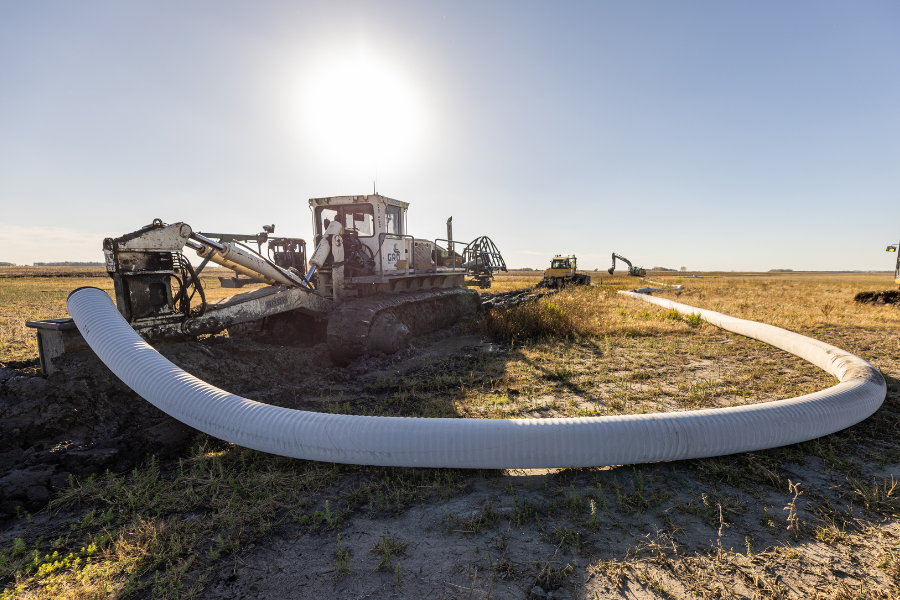
“Does drain tile cause downstream flooding?” is one of the most common concerns raised about drain tile, and one of the most misunderstood. The question usually goes something like this: If you're moving water off your field faster, doesn't that water have to go somewhere? And doesn't that mean more water downstream, faster?
It's a reasonable thing to wonder. And it deserves a straight answer.
Where the Concern Comes From
The concern makes intuitive sense on the surface. Drain tile removes water from a field. That water discharges through an outlet. The outlet connects to a ditch, slough, or waterway. Therefore, more water, faster, downstream.
But that line of thinking skips over how water actually moves across farm ground, and how a properly designed drainage system changes that movement.
What Research Actually Shows
This isn’t a new question. It’s been studied for years, and the findings are consistent: Properly designed drain tile systems do not increase downstream flooding. In many cases, they actually reduce peak flow rates. Here’s why:
Undrained Fields: Fast, Uncontrolled Runoff
Fields without drainage hold water until they reach saturation. Once that happens, any additional rainfall has nowhere to go. It runs off the surface, fast. That surface runoff moves quickly into ditches and waterways, contributing to sharp spikes in water levels downstream.
Tiled Fields: Controlled, Subsurface Movement
Drain tile changes removes excess moisture, introducing more oxygen, thus allowing more water into the soil during heavy rain events. Instead of moving across the surface, water moves through the soil profile and into the tile system. From there, it’s discharged gradually through a controlled outlet. Not all at once, not in a surge, just managed flow. That reduction in surface runoff is a big part of why properly designed systems don’t create the flooding problems people assume they do.
Where Problems Can Come From
It’s worth being direct about this. Not every drainage project is done the right way.
A poorly planned system, one that ignores outlet capacity, skips permitting, or doesn’t account for downstream conditions, can create issues. That is not a myth, and that is why design matters. Proper outlet sizing, correct grade and system layout, understanding downstream capacity, following regulatory requirements are not extra, they’re part of doing the job right.
The Role of Permitting and Local Oversight
In North Dakota, drainage projects don’t happen in a vacuum. They often involve oversight from:
- NRCS
- Local water resource districts
- Easements and neighbor coordination
Those steps exist for a reason, to make sure water is being managed responsibly across the landscape, not just within one field.
At GRO Drain Tile, permitting and coordination are part of every project. We handle that process from the start, so nothing gets overlooked.
What Actually Causes Downstream Issues
If you step back and look at it clearly, the bigger risk isn’t managed drainage. It’s unmanaged water. Fields that saturate and shed runoff quickly, with no system in place, are what can contribute to sudden, high-volume flows downstream.
Drain tile, when designed and installed correctly, does the opposite. It slows things down, spreads discharge out over time, and gives water a controlled path out of the field.
Questions About Your Field?
If you’ve heard concerns about downstream impact and want to understand how a system would work on your ground, we’re happy to walk through it with you.
At GRO Drain Tile, we handle the design, the permitting, and the complexity — so you can focus on the work that matters.
Call (701) 490-2109 or Contact Us Today